A Heritage Walk Through Colootola: The 168-Year-Old Legacy of Badan Chand Roy Bari
There is a distinct fragrance that hangs in the morning air of Kolkata as autumn arrives. It is a fragile blend of blooming night-flowering shiuli flowers resting on dew-soaked grass, the faint woodsmoke of morning tea stalls, and the distant, rhythmic rumble of the dhaak. For generations of Calcuttans and travelers who make their annual pilgrimage back to Bengal, Durga Puja is far more than a festival—it is an emotion that defies simple explanation.
Yet, over the last two decades, the festival landscape has dramatically shifted. Modern Kolkata during Sharodotsav often feels like an expansive open-air carnival of spectacle. Millions queue under neon signs for hours to glimpse colossal architectural replicas, kinetic lighting marvels, and contemporary installation art conceptualized by government college artists. While these modern theme extravaganzas are undeniably breathtaking, there is another world hidden quietly behind the bustling avenues—a world untouched by the clamor of corporate sponsorships and LED billboards.
To find it, you must leave behind the grand boulevards and venture into the labyrinthine alleys of North and Central Kolkata. Here, tucked inside quiet residential lanes where tram wires crisscross overhead, stand the city’s aristocratic ancestral mansions—the Bonedi Baris. And among these venerable households, none possesses a more tranquil, atmospheric charm than the historic residence of Badan Chand Roy Bari in Colootola.
The Labyrinth of Colootola: Stepping Into 19th-Century Calcutta
Colootola today is an energetic, bustling quarter of Central Kolkata, sandwiched between the scholarly pulse of College Street and the bustling commerce of Chittaranjan Avenue. During ordinary weekdays, its narrow lanes hum with hand-pulled rickshaws, wholesale bookbinders, attar merchants, and medical students walking briskly toward Calcutta Medical College.
Yet, when you step off Central Avenue and turn into Gopal Chandra Lane, the frantic noise of modern Kolkata begins to soften. The roadway narrows. High-walled brick mansions rise on either side, their faded green louvered shutters (khorkhori) standing half-open against the autumn sun. Heavy wrought-iron balconies jut out over the cobblestones, supported by weather-worn stucco corbels.
At 2A Gopal Chandra Lane, an imposing iron-studded wooden gate marks the entrance to the palatial mansion of Babu Badan Chandra Roy. Stepping across this threshold feels like parting an invisible curtain of time. The roar of vehicular traffic vanishes, replaced instantly by the resonant strike of a bronze bell, the heady scent of smoldering dhuno (Indian frankincense), and the warm, golden glow of vintage European chandeliers illuminating a grand inner courtyard.
You can view the full transit details and map location directly on our Badan Chand Roy Bari Directory Page.
The Genesis: Who Was Babu Badan Chandra Roy?
To truly appreciate the solemn grace of this household, one must understand the era from which it arose. The mid-19th century was a golden age of intellectual and economic transformation in Bengal. Following the establishment of the British East India Company’s commercial hub, a new class of Bengali merchant aristocracy (abhijato sreni) emerged. These were astute businessmen, scholars, and philanthropists who amassed considerable fortunes through shipping, real estate, and inland trade, while remaining deeply anchored in traditional Sanatan spiritual heritage.
Babu Badan Chandra Roy was one such prominent merchant of his day. In 1858—a historic year marked by India transitioning under the British Crown—Badan Chandra Roy inaugurated the family’s first autumn Durga Puja inside his newly erected ancestral home.
Unlike many landlords who hired local traditional masons, Roy commissioned the premier British architectural and engineering firm of the era: Messrs. Mackintosh Burn & Company. The firm, renowned for designing Calcutta’s landmark colonial public structures, brought a unique blend of Victorian neoclassical elegance and traditional Bengali domestic architecture to the residence.
For 168 unbroken years, through colonial upheaval, partition, and the rapid modernization of Kolkata, the descendants of Badan Chandra Roy have gathered in this very house each autumn to welcome the Mother Goddess with the exact same humility and reverence established by their founding patriarch.
Architectural Splendor: The Arched Thakurdalan and Courtyard
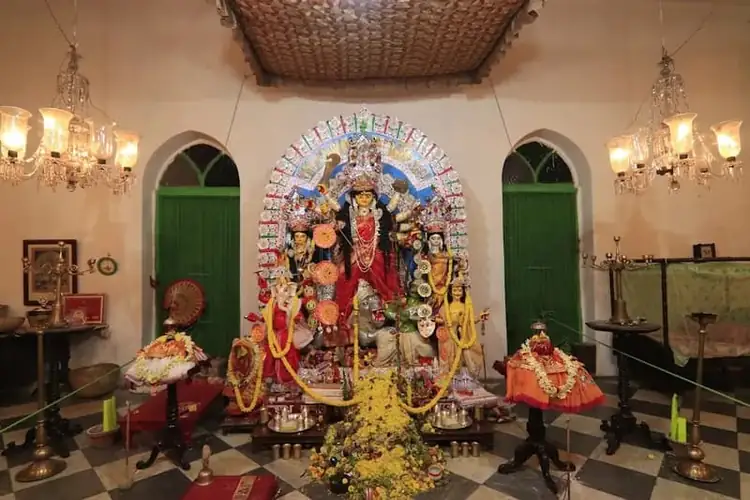
At the physical and spiritual heart of Badan Chand Roy Bari lies its magnificent Thakurdalan—the sacred raised pavilion where the deity is consecrated and worshipped.
The courtyard architecture is a masterclass in classic colonial-Bengali design:
- The Semicircular Arches: The thakurdalan is supported by imposing masonry columns topped with Corinthian-inspired capitals, framing elegant semicircular arches that open out onto a spacious, sunlit central quadrangle (uthon).
- The Open-Sky Courtyard: The central open courtyard serves as a natural gathering space. Looking upward, multiple tiers of residential verandas wrap around the quadrangle, where generations of family members once peered down to witness the rituals unfolding below.
- The Glass Chandeliers: Suspended from high timbered ceilings are antique Belgian cut-glass chandeliers and brass oil-lantern brackets dating back to the late 1800s. During evening Aarati, when these chandeliers are lit and cast their refracted light across the polished lime-and-mortar floor, the courtyard feels genuinely ethereal.
Unlike community pandals built of bamboo and canvas that are dismantled within a week, the thakurdalan at Badan Chand Roy Bari carries the accumulated sanctity of more than a century and a half of continuous prayer, tears, laughter, and devotion.
Sacred Rituals: The Serenity of a Pure Vaishnav Puja
One of the most fascinating aspects of Kolkata’s Bonedi Bari pujas is how each family observes distinct rituals inherited from their ancestors. While many aristocratic zamindar households across Bengal followed the Shakta tradition—which historically included animal sacrifices (Pashuboli) during Sandhi Puja—the Roy family of Colootola has been staunchly Vaishnav since its inception.
Vaishnavism emphasizes Ahimsa (non-violence), deep personal devotion, and unconditioned love for the divine. Consequently, no animal sacrifice has ever taken place within the walls of Badan Chand Roy Bari.
Instead, the family strictly adheres to the sacred ritual of Satvik Balidan:
- Vegetable & Fruit Sacrifice: During the critical transition between Maha Ashtami and Maha Navami—known as Sandhi Puja—symbolic sacrifices are performed using whole sugarcane stalks, chalkumro (ash gourd), and seasonal bananas.
- The 108 Earthen Pradeeps: As the dhaakis play a measured, hypnotic cadence, 108 terracotta oil lamps are meticulously arranged and lit before Maa Durga. The soft flickering glow illuminating the deity’s face during this twilight hour is a sight that leaves spectators spellbound.
- The Anna Bhog: In accordance with Vaishnav rites, the food offerings (Bhog) consist of pure vegetarian delicacies: luchi fried in pure ghee, aromatic radhaballabhi, sweetened chholar dal, seasonal vegetable curries (labra), homemade sweets, and seasonal fruits arranged in silver salvers. No onion, garlic, or cooked rice (anna) is offered to the deity during the main daytime rituals.
The Divine Craft: Sabeki Ekchala and the Glint of Daker Saaj
In modern commercial pujas, idol styles change dramatically every year based on contemporary design themes. In contrast, at Badan Chand Roy Bari, the image of Maa Durga remains untouched by passing fashion. She appears in her timeless, classical Sabeki Ekchala form.
In the Ekchala tradition:
- A Single Unified Canvas: Maa Durga, along with her four divine children—Lakshmi, Saraswati, Kartik, and Ganesha—and her vahana the lion, are sculpted together under a single, semi-circular arched backdrop called the Chalchitra.
- On-Site Sculpting: Months before the festival, on the auspicious day of Rath Yatra, the clay foundation (Kathamo Puja) is blessed. Master hereditary artisans from Kumartuli arrive at the household courtyard to sculpt the deity using sacred Ganges silt, straw, and clay.
- Daker Saaj (Silver Foil Embellishments): The deity is adorned with exquisite Daker Saaj. Historically, this lightweight silver foil ornament was imported by post (daak) from Germany by wealthy families. The silver ornaments, combined with delicate handcrafted sholapith (reed pith) crowns and ornaments, give Maa Durga an aura of regal yet motherly benevolence. Her large, almond-shaped eyes (Trinayani) gaze out with peaceful poise rather than fierce wrath.
The Central Kolkata Heritage Circuit: A Walking Guide
If you are planning an authentic Bonedi Bari walking tour, Colootola makes an ideal central anchor. Because these heritage houses are located in close proximity throughout North and Central Kolkata, you can easily cover several historic households on foot within a single morning or afternoon.
Here is a curated heritage walking route starting from Badan Chand Roy Bari:
-
Stop 1: Badan Chand Roy Bari (Colootola Roy Bari)
Address: 2A, Gopal Chandra Lane, Colootola (Off C.R. Avenue)
Nearest Landmark: Calcutta Medical College & Central Metro Station (Gate No. 2).
Highlight: Mackintosh Burn architecture, Vaishnav Satvik rituals, peaceful thakurdalan. -
Stop 2: Thanthania Dutta Bari
Walking Distance: ~10 minutes north along College Street.
Address: Bidhan Sarani, near Thanthania Kalibari.
Highlight: Founded in 1788 by Dwarakanath Dutta; famous for its classical idol and historic brass chariot. -
Stop 3: Chorbagan Mitra Bari
Walking Distance: ~8 minutes northwest toward Muktaram Babu Street.
Address: Muktaram Babu Street.
Highlight: Celebrated for its unique musical heritage and magnificent columned courtyard. -
Stop 4: Jorasanko Shib Krishna Daw Bari
Walking Distance: ~12 minutes toward Vivekananda Road.
Address: 12, Shib Krishna Daw Lane.
Highlight: Renowned for its theatrical, diamond-and-jeweled silver crown adornments and grand double-storied courtyard. -
Stop 5: Pataldanga Basu Mullick Bari
Walking Distance: ~10 minutes back toward Radhanath Mullick Lane.
Address: 18 Radhanath Mullick Lane.
Highlight: Historic home that once hosted Swami Vivekananda and Sri Aurobindo during the freedom movement.
You can plan this entire circuit and discover live walking navigation using our interactive Puja Route Planner.
Essential Visitor Tips & Heritage Etiquette
Visiting a family Bonedi Bari is fundamentally different from entering a commercial barowari club pandal. You are stepping inside an active private family home that graciously opens its doors to cultural visitors. Keeping a few basic etiquettes in mind ensures a rewarding experience for both visitors and hosts:
- Best Time to Visit: The best hours are between 8:00 AM and 12:30 PM during Maha Saptami, Maha Ashtami, and Maha Navami. The morning rituals, anjali, and aarati are conducted during this window, and crowds are manageable. Alternatively, visit between 5:30 PM and 8:30 PM for the evening lamps and musical prayers.
- How to Reach: Take the Kolkata Metro (Blue Line) to Central Metro Station. Exit through Gate No. 2 toward Medical College, walk south along Chittaranjan Avenue for 200 meters, and take the left turning into Colootola Street (Maulana Shaukat Ali Street). Turn left again into Gopal Chandra Lane.
- Footwear & Attire: Remove your shoes before stepping onto the raised platform of the thakurdalan. Modest, respectful attire is appreciated as solemn Vedic and Vaishnav mantras are chanted.
- Photography: Cultural and architectural photography is generally welcomed by the family, but refrain from using intrusive flash photography directly in front of the priests during sacred rituals like Sandhi Puja.
- Engage Politely: If you encounter senior family members sitting on the veranda, take a moment to politely greet them with a “Subho Sarodotsav”. Many elders take immense pride in sharing obscure historical anecdotes about their ancestors and the mansion’s construction.
A Heritage Food Trail: Old Calcutta’s Iconic Flavors
No heritage walk through Central Kolkata is complete without indulging in the storied culinary institutions that have fueled the city’s intellectuals and festival-goers for a century. After completing your morning visit to Badan Chand Roy Bari, take a short stroll toward College Square and treat your palate:
- Paramount Sherbets & Syrups (Bankim Chatterjee Street): Established in 1918, this legendary wood-paneled soda fountain was once a secret meeting ground for Indian freedom fighters. Order their famous Daab Sharbat (tender coconut water blended with sweet malai) or the Kaju Draksha.
- Putiram Sweets (Amherst Street / Surya Sen Street crossing): A sacred temple of Bengali breakfast since 1852. Stand by the marble counter and savor hot, fluffy radhaballabhi served with spiced chholar dal, followed by a warm, fragrant chhanar jilapi.
- Dilkhusha Cabin (MG Road crossing): Founded in 1907, this historic cabin served luminaries like Netaji Subhas Chandra Bose. Drop in for their signature crispy Mutton Kobiraji Cutlet accompanied by pungent mustard sauce (kasundi).
Preserving the Living Heritage of Bengal
In an era of fleeting digital trends, virtual reality installations, and multi-crore festival budgets, places like Badan Chand Roy Bari serve as invaluable living time capsules. They remind us that the true essence of Bengal’s Durga Puja does not lie in how brightly a laser light shines or how towering a pandal ceiling climbs.
Instead, it lives in the sacred smoke curling upward from the dhunachi, the measured beat of the dhaak bouncing off hundred-year-old lime-washed arches, and the warmth of a family welcoming an entire city into their ancestral courtyard year after year.
As you plan your pandal hopping itinerary for Durga Puja 2026, step away from the crowded barricades for a morning. Take a slow walk through the storied cobblestones of Colootola. Stand quietly beneath the arched thakurdalan of Babu Badan Chandra Roy, breathe in the fragrance of camphor, and witness the timeless heartbeat of old Calcutta.
For complete pandal listings, transit maps, and real-time crowd updates across Kolkata, explore our full Kolkata Durga Puja Directory and stay updated with the official Puja Schedule 2026.